
CIET Certificate 1

A comprehensive Certificate in Integrative Endocrinology Therapies delivered over 3 months with 300CPD Hours for healthcare, rehabilitation and wellness professionals who want to blend modern endocrine science with holistic therapies for hormone health, diabetes and thyroid wellness, metabolism, stress regulation and patient well-being.
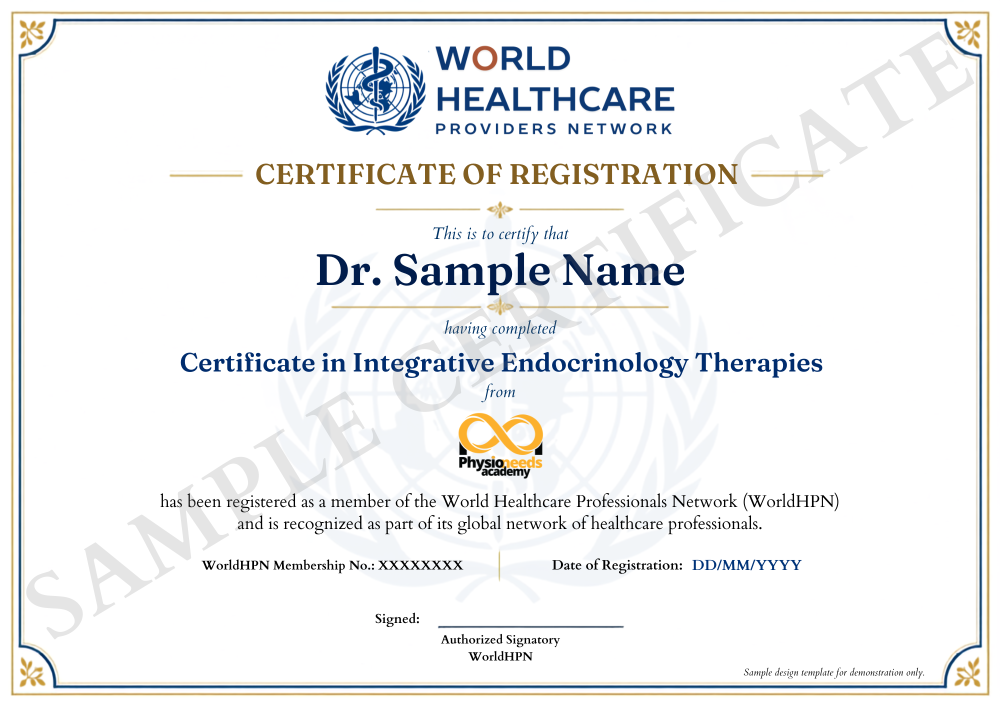
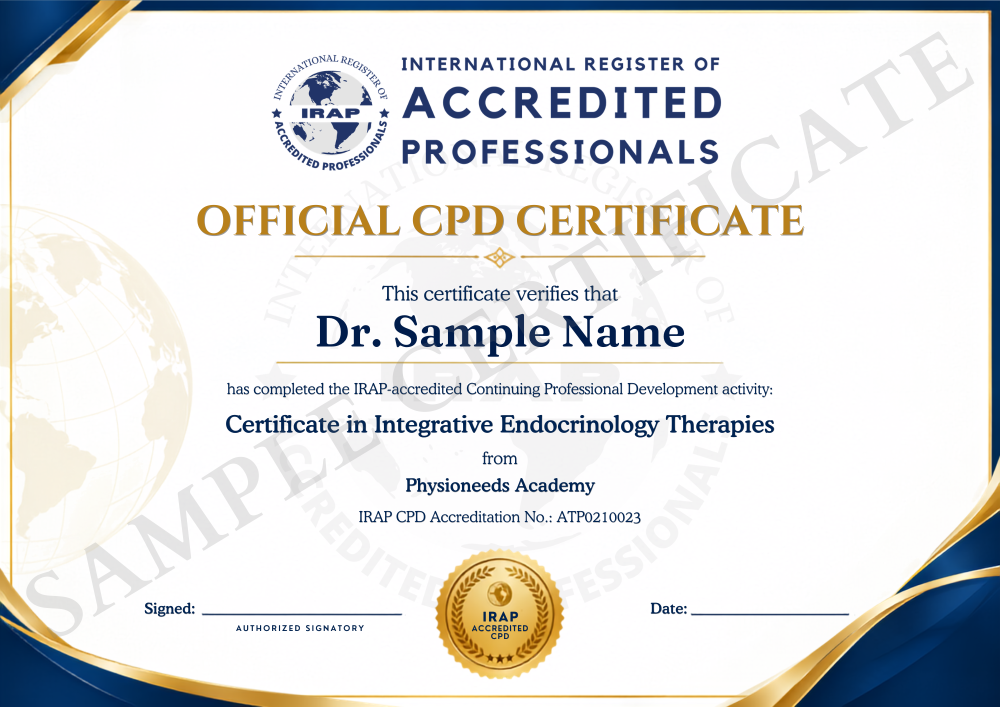
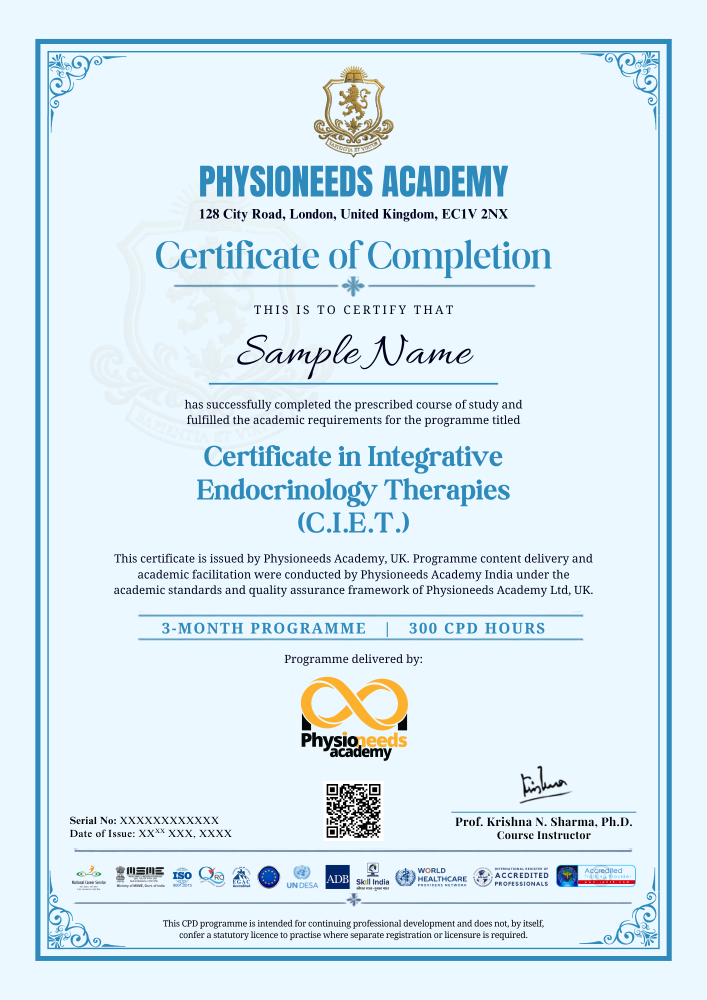
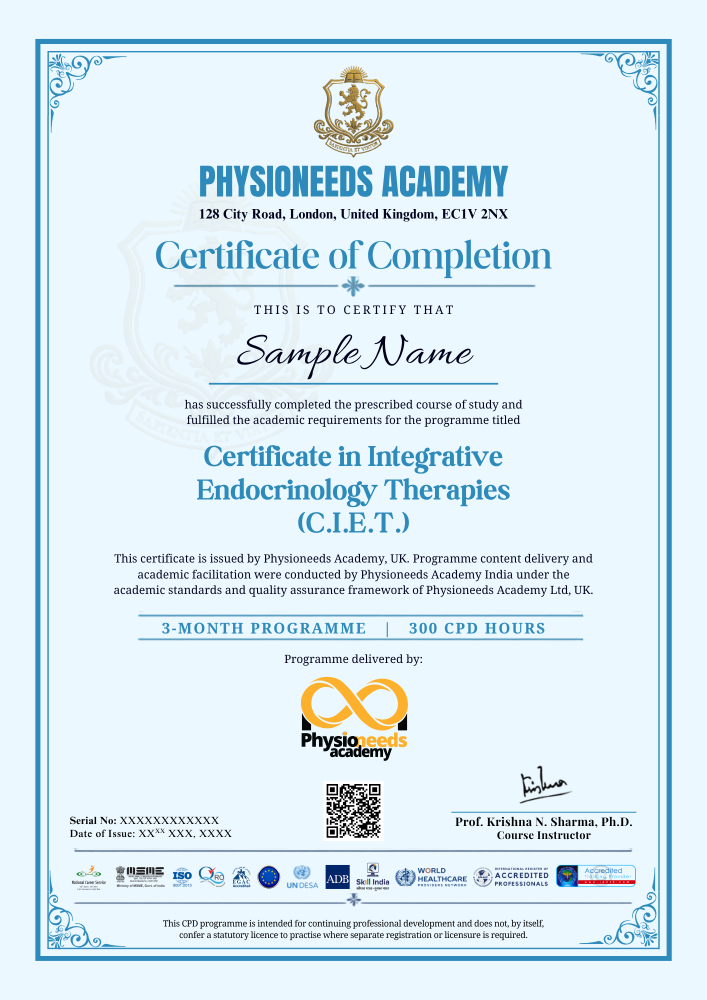
Explore the certificate formats associated with the Certificate in Integrative Endocrinology Therapies.
Explore the organisations, registrations and professional recognition associated with Physioneeds Academy.
You understand clinical care, but endocrine cases often need lifestyle education, stress support, nutrition awareness, emotional balance and personalized holistic planning.
Your profile can become stronger when you add complementary endocrinology, mind-body methods and integrative therapies to your clinical skill set.
Acupressure, Sujok, reflexology, EFT, yoga, meditation, aromatherapy and nutrition become useful when you understand where they fit in endocrine wellness.
You want to support patients with stress, fatigue, weight concerns, mood imbalance and lifestyle barriers using practical integrative endocrinology tools.
Medication awareness alone is not enough; patients also need better sleep, mindset, nutrition, relaxation, movement and consistent wellness habits.
CIET suffix, integrative endocrinology certification and expert-led learning help you position as a holistic endocrine care professional.
Understand endocrine system fundamentals, human anatomy, physiology and complementary therapy principles for holistic care.
Learn acupressure, reflexology, Sujok, EFT tapping, aromatherapy, color therapy, crystal healing and energy-based methods.
Use yoga, meditation, mindfulness, music therapy and hypnotherapy to support relaxation, stress control, emotional balance and lifestyle consistency.
Apply integrative approaches to diabetes wellness, thyroid imbalance, adrenal stress, metabolic concerns, PCOS, obesity and hormone-related lifestyle challenges.
Each therapy is connected with endocrine wellness, stress reduction, lifestyle support, metabolic balance and personalized care so you can integrate it safely with modern healthcare practice.
The linked brochure lists complementary and alternative medicine management topics for 30 endocrinology conditions, including diabetes mellitus, thyroid disorders, PCOS, osteoporosis, pituitary disorders and other endocrine conditions.
A 3-month, 300CPD Hours pathway for healthcare, rehabilitation and wellness professionals who want a clear progression from integrative therapy foundations to complementary endocrine wellness, hormone health support and case-based holistic care.
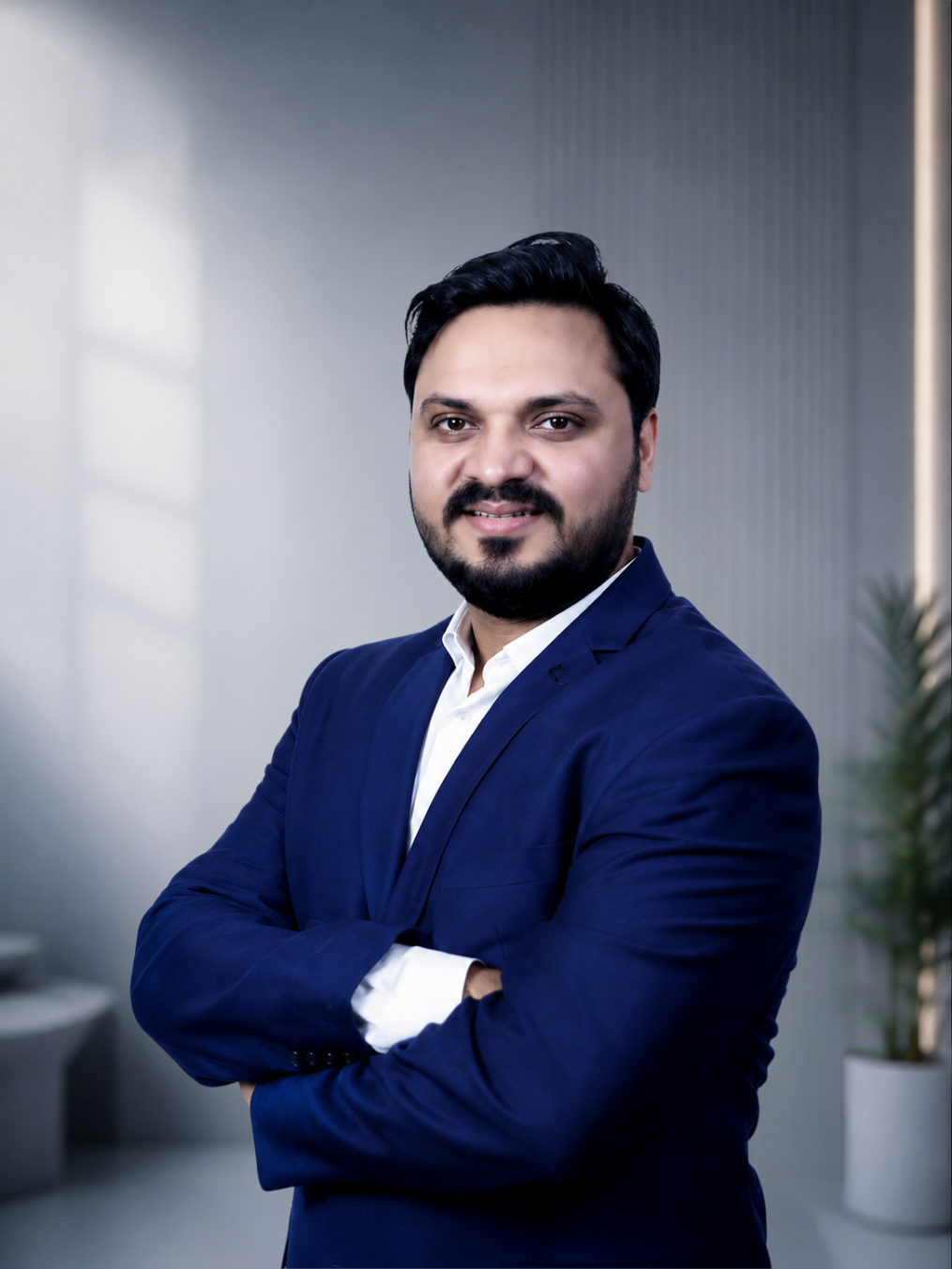
Prof. (Dr.) Krishna N. Sharma brings global teaching authority, integrative healthcare insight and practical education experience across manual therapy, physiotherapy, holistic care and integrative endocrinology learning.
After successful completion of the Certificate in Integrative Endocrinology Therapies, learners receive a professional CIET certification that validates their training in holistic endocrinology care, hormone health support, diabetes and thyroid wellness, metabolic health, stress regulation, nutrition, mind-body practices and patient-centered integrative endocrine care.
Step-by-step learning across acupressure, Sujok, reflexology, EFT, yoga, meditation, aromatherapy and holistic endocrine wellness.
Structured continuing professional development across integrative endocrinology foundations, practical applications and holistic wellness support.
Practical demonstrations, real-world applications and clinical learning for integrative endocrinology care.
Lifetime access to material so learners can revisit and revise core integrative therapy concepts.
A structured three-month Certificate programme built for healthcare, rehabilitation, clinical and wellness professionals.
Learn within a program led by an educator whose teaching has reached 350,000+ students across 193 countries.
Multiple payment options available. Choose full payment or EMI payment in the secure plan popup.
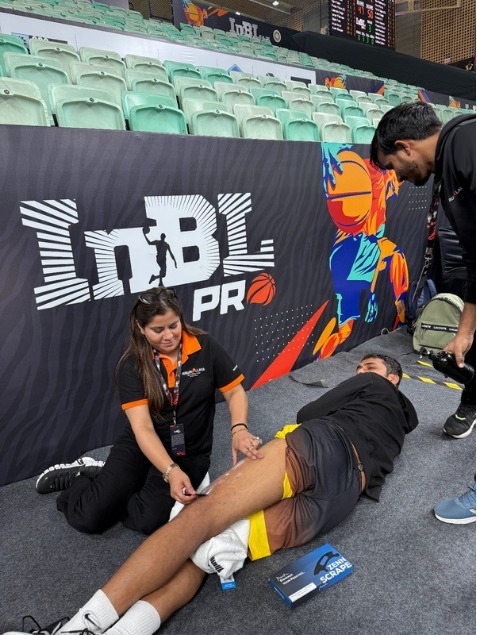
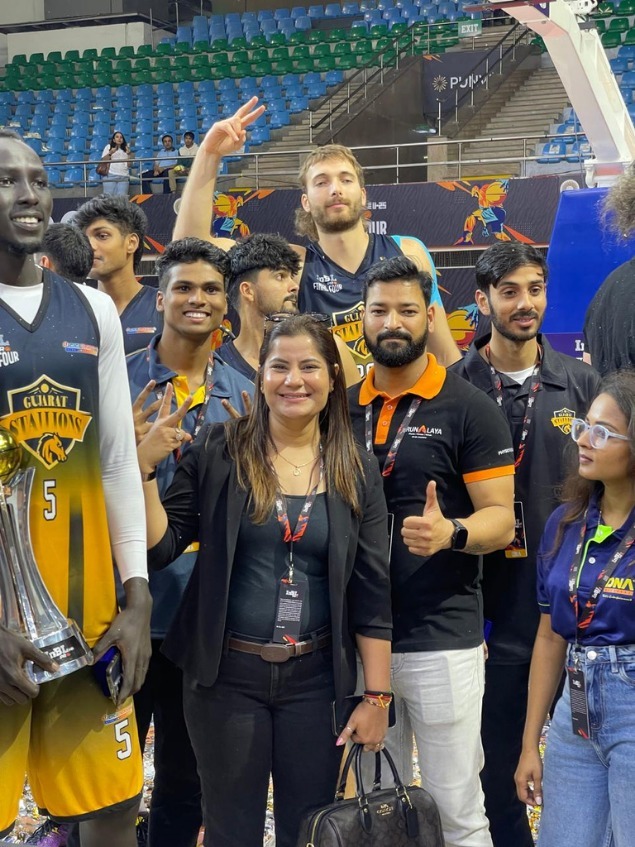
Real-world sports physiotherapy exposure in a professional basketball environment.
Add your best CIET student reviews here with names, city, qualification and short integrative endocrinology outcome.
Earlier I only understood conventional endocrine support. Now I can integrate complementary therapies for stress, lifestyle, nutrition and hormone wellness support.
— Student TestimonialThe integrative therapy explanations, practical demos and case-based approach made the course useful for clinical and wellness practice.
— Student TestimonialCIET gave me better confidence, stronger positioning and clearer ways to support patients through holistic, mind-body and complementary care.
— Student TestimonialThe Certificate in Integrative Endocrinology Therapies (CIET) is a 3-month, 300CPD Hours, mentor-led Certificate programme from Physioneeds Academy for healthcare, endocrine wellness and wellness professionals who want to learn how complementary and holistic approaches can support comfort, relaxation, stress balance, metabolic and hormonal wellness and patient education around endocrine health — alongside, and never in place of, conventional endocrine medical care. Across 20+ therapies and 30 endocrinology wellness topics, it teaches complementary methods as supportive care, with clinical judgment and qualified medical care kept central, and on completion you earn the CIET suffix. It is mentored by Prof. (Dr.) Krishna N. Sharma.
CIET is designed for healthcare, endocrine wellness and wellness professionals who want a structured way to offer holistic, wellness-focused support around endocrine health — comfort, relaxation, stress balance, metabolic and hormonal wellness and patient education. It is intended to complement, not replace, the care patients receive from endocrinologists and other qualified medical professionals.
Yes — CIET welcomes healthcare, endocrine wellness and wellness professionals. Each learner applies the complementary approaches within their own professional scope and local regulations, and always as supportive, wellness-focused care rather than as medical treatment. Diagnosis, treatment and management of any endocrine condition always remain with qualified medical professionals.
CIET is a strong choice for professionals who want to learn, in a structured and responsible way, how complementary approaches can support comfort, relaxation and metabolic and hormonal wellness alongside conventional endocrine care. It teaches acupressure, reflexology, Sujok, EFT, yoga, meditation, nutrition education and more with a clear emphasis on safety and keeping conventional endocrinology central — plus the CIET suffix, a 3-month, 300CPD Hours pathway and lifetime access.
CIET's difference is structure, safety and honest positioning. Rather than random natural remedies, it teaches endocrine-system wellness context, endocrine wellness concepts, safe complementary-care principles and clear boundaries — so complementary methods are used only as supportive, wellness-focused comfort and education, never as a substitute for medical diagnosis or treatment. You learn where supportive approaches fit, and, just as importantly, where they do not.
CIET stands for the Certificate in Integrative Endocrinology Therapies, and after successful completion of the 3-month, 300CPD Hours programme you may use the CIET suffix after your name as per Physioneeds Academy guidelines. The certificate is issued by Physioneeds Academy and mentored by Prof. Krishna N. Sharma, recognising structured learning in holistic endocrine-wellness support.
No — this is essential to understand. CIET is a professional-development certificate in complementary and wellness education; it is not a medical or endocrinology qualification, and the therapies it teaches do not treat, cure or manage endocrine conditions. They are taught only as supportive, wellness-focused comfort, relaxation and cognitive-wellness education that complements conventional endocrine care. Conditions such as stroke, epilepsy, Parkinson's disease, multiple sclerosis, Alzheimer's disease and traumatic brain injury must always be diagnosed and managed by qualified medical professionals, and complementary approaches must never delay or replace that care or any prescribed medication.
In CIET, integrative endocrinology means combining conventional endocrine care with complementary, wellness-focused approaches that support comfort, relaxation, stress balance and metabolic and hormonal wellness — always led by qualified medical care. The course covers 20+ complementary therapies (point-based, mind-body, nutritional and lifestyle) as supportive, patient-centered wellness education, with clinical judgment and conventional endocrinology kept central throughout.
Yes. CIET begins with foundations — endocrine-system basics, endocrine wellness concepts and CAM principles — so you understand endocrine cases with stronger clinical reasoning before applying supportive methods. This foundation is what allows complementary approaches to be used responsibly, as supportive wellness care within clear limits.
Yes — as supportive comfort and relaxation approaches only. You learn acupressure, reflexology and Sujok concepts for supportive endocrine wellness, stress regulation, nerve comfort and patient education, with careful attention to safety. These are wellness-support approaches, not treatments for endocrine conditions, and always sit alongside conventional endocrine care.
Yes. CIET applies EFT, yoga, meditation, mindfulness, music therapy and relaxation-based practices to support emotional balance, metabolic and hormonal wellness and endocrine wellness confidence. These are supportive wellness practices — not treatments for endocrine disease and never a replacement for medication — and, where a patient has clinical needs, they sit alongside care from qualified professionals.
Yes, as supportive relaxation and emotional-wellness support only. CIET frames EFT and relaxation concepts as tools for stress balance and emotional wellbeing — never as treatment for any endocrine or psychological condition. Any patient with clinical concerns should be assessed and cared for by qualified medical professionals.
Yes — as general healthy-lifestyle education. CIET includes nutrition education, phytotherapy, aromatherapy, Bach flower and holistic-living concepts framed as supportive lifestyle wellness. Any specific dietary, herbal or medical decision — especially for someone with a endocrine condition or on medication (for example anti-epileptic drugs) — should be guided by their doctor, given the real risk of interactions.
CIET teaches complementary approaches with a strong, honest emphasis on safety. Complementary methods are presented only as gentle, supportive, wellness-focused care — for comfort, relaxation and metabolic and hormonal wellness — with careful attention to individual limits. Not every approach suits every person, evidence varies, and complementary care must always defer to the patient's endocrinologist and conventional medical care, especially given the seriousness of many endocrine conditions and medication interactions. When in doubt, the safe answer is to refer to qualified medical professionals.
This is the defining principle of CIET: complementary approaches are taught as supportive, wellness-focused care that complements conventional endocrinology and never replaces it. Diagnosis, treatment, medication and management of any endocrine condition remain with qualified medical professionals. CIET teaches you to support comfort, relaxation and metabolic and hormonal wellness within that boundary — and to recognise when a patient needs medical care and refer promptly.
CIET's curriculum references endocrinology conditions — including migraine, peripheral neuropathy, stroke rehabilitation support, Parkinson's disease, multiple sclerosis, Bell's palsy, epilepsy and others — but ‘support’ means only general comfort, relaxation and cognitive-wellness education alongside medical care. It does not mean treating or managing the condition. The condition itself is always diagnosed, monitored and managed by qualified medical professionals, including all medication.
No. CIET is clear and honest about this: complementary approaches do not treat, cure, reverse, manage or slow the progression of stroke, epilepsy, Parkinson's disease, multiple sclerosis, Alzheimer's disease, ALS, traumatic brain injury or any endocrine condition. For patients living with these, complementary methods may only offer supportive comfort, relaxation and cognitive-wellness wellbeing — alongside, and never in place of, medical care, monitoring and medication from qualified professionals. Complementary approaches must never delay diagnosis, replace prescribed treatment, or lead anyone to stop or change medication such as anti-epileptic drugs.
These are medical emergencies. Stroke symptoms (facial drooping, arm weakness, speech difficulty — act FAST), a seizure, a serious head injury, sudden severe headache, or sudden weakness or numbness require immediate emergency medical care — call local emergency services at once. Complementary, wellness-focused approaches are never an appropriate response to an acute endocrine event. CIET teaches professionals to recognise red flags and to keep conventional endocrinology firmly in the lead.
Yes — this is the appropriate heart of CIET. It focuses on supportive comfort, relaxation, stress balance, metabolic and hormonal wellness and healthy-lifestyle education that support general wellbeing within the boundaries of conventional medical care. Helping patients feel more comfortable and supported — alongside their medical care and any endocrine wellness — is where complementary endocrine support is most responsibly applied.
Yes — safety and referral are central to CIET. You learn to recognise red flags, understand the limits of complementary support, respect medication and interaction risks, and refer or defer promptly to qualified medical professionals whenever a patient's presentation calls for medical care. Knowing when to escalate — especially for stroke signs or seizures — is the most important skill of responsible complementary practice.
Yes. CIET includes practical demonstrations and case-based, real-world thinking across the complementary approaches and endocrinology wellness topics, always within the safe, supportive-not-treatment framing. This helps you apply gentle wellness support responsibly and recognise the boundaries clearly.
Yes — emphatically. CIET emphasises scope and responsible use: complementary approaches are supportive, wellness-focused comfort and education only; conventional endocrinology leads all diagnosis, treatment and medication; and professionals must work strictly within their scope and refer to qualified medical professionals. Responsible, honest positioning protects patients and your professional credibility.
CIET frames the outcomes honestly and modestly: complementary approaches may support general comfort, relaxation, stress balance, sleep, emotional balance and metabolic and hormonal wellness — alongside conventional endocrine care and any endocrine wellness. These are general wellbeing supports, not treatments or cures for any endocrine condition, and they never replace the care, monitoring or medication provided by qualified medical professionals.
CIET suits healthcare, endocrine wellness and wellness professionals who want a structured, responsible way to offer supportive, wellness-focused comfort, relaxation and cognitive-wellness education — while keeping conventional endocrinology central. It is for those who want to add holistic wellness support to their practice within clear, safe boundaries.
They may offer general support for relaxation, sleep and stress balance as part of overall wellbeing — for example through mindfulness, calming routines and music. CIET teaches these as supportive wellbeing tools, not as treatments for any endocrine, sleep or psychological condition; any clinical concern should be assessed by qualified professionals.
CIET helps you position as a holistic endocrine-wellness professional — offering safe, supportive comfort, relaxation and cognitive-wellness education — by building structured skills and adding the CIET suffix. This can strengthen your profile for clinics, endocrine wellness centres and wellness settings, always within your scope and always complementing conventional endocrine care.
Yes. CIET is built around practical demonstrations and case-based thinking across complementary approaches and endocrinology wellness topics, within the safe, supportive-not-treatment framing, so you can apply gentle wellness support responsibly in real-world, patient-centered settings.
Yes. CIET is designed to strengthen your profile and skills for clinics, endocrine wellness centres and wellness settings — giving you a structured, credible way to offer supportive endocrine-wellness education alongside conventional care, within your scope.
CIET is a structured 3-month, 300CPD Hours pathway in three phases: Endocrinology Foundations and CAM Care (endocrine-system basics, endocrine wellness context, holistic principles and clinical reasoning for choosing complementary therapies); Point-Based and Mind-Body Skills (acupressure, reflexology and Sujok; EFT, yoga, meditation and mindfulness for stress and endocrine-system regulation; music therapy, hypnotherapy and relaxation for comfort); and Condition-Based Integration (supportive wellness planning across 30 endocrinology topics, nutrition, phytotherapy, aromatherapy and holistic living) — all within a supportive-not-treatment, medical-care-central framing.
Yes. CIET is delivered online with practical demonstrations and flexible learning, and includes lifetime access so you can revisit and revise the core concepts whenever needed.
Yes. CIET includes practical demonstrations and case-based, real-world thinking across the complementary approaches and endocrinology wellness topics, always within the safe, supportive-not-treatment framing.
CIET is mentored by Prof. (Dr.) Krishna N. Sharma — a nine-time world record holder, educator and author of over 400 books including 40+ bestsellers, known for global healthcare education and for blending endocrine-wellness education with complementary and holistic approaches. You learn from an internationally recognised educator.
CIET is designed for healthcare, endocrine wellness and wellness professionals. It builds from CAM foundations through complementary approaches to supportive, patient-centered wellness planning, so motivated professionals can follow it, applying everything within their own scope and local regulations, and always alongside conventional endocrine care.
Yes. CIET includes step-by-step practical demonstrations and case-based application, within the safe, supportive-not-treatment framing, so you can see how gentle wellness support and cognitive-wellness education are applied responsibly for endocrine wellbeing.
On successful completion of the 3-month, 300CPD Hours programme you receive a professional Certificate in Integrative Endocrinology Therapies (CIET) from Physioneeds Academy — a professionally issued certificate you can share on LinkedIn, your clinic profile and professional portfolios, with the right to use the CIET suffix. It recognises structured learning in holistic endocrine-wellness support, mentored by Prof. Krishna N. Sharma.
Yes — CIET carries 300CPD Hours as a 3-month Certificate programme, supporting structured continuing professional development in integrative endocrine-wellness support.
CIET offers multiple payment options — full payment or EMI / installment plans through a secure checkout. For the current fee and active offer, check the course page or speak to the Physioneeds Academy team. Flexible payment options keep the 3-month, 300CPD Hours programme accessible to students and working professionals.
You can enrol directly on the CIET course page at https://www.e-physioneeds.com by choosing full payment or an EMI plan in the secure checkout, or speak to a counsellor first on call or WhatsApp at +91 99909 93318, +91 99901 00373 or +91 88002 20066. After enrolling, you get the 3-month, 300CPD Hours pathway, practical demonstrations, mentor guidance and lifetime access to the content.
CIET bundles 20+ complementary approaches into one integrative pathway focused on endocrine-wellness support and cognitive-wellness education — ideal if you want a broad, specialty-focused, responsibly-framed skill set. Individual therapy certifications (for example acupressure, yoga or reflexology) go deeper into a single method, while other integrative certificates apply the same holistic toolkit to a different specialty (mental health, geriatrics, pain management and more). Choose CIET for integrative breadth in endocrine-wellness support; add a single-therapy course for depth, or another integrative certificate to cover a further specialty.
CIET is designed to help you position as a holistic endocrine-wellness professional — offering safe, supportive comfort and cognitive-wellness education — by building a structured skill set and adding the CIET suffix. This can strengthen your profile across clinics, endocrine wellness centres and wellness practice. As with any qualification, outcomes depend on how you apply the learning, within your scope of practice and always alongside conventional endocrine care.
Physioneeds Academy is the specialised clinical physiotherapy education brand of Ashira Innovations Pvt Ltd, headquartered in Patel Nagar, New Delhi, offering advanced CPD and certification courses for physiotherapists in India and internationally. Our programmes focus on practical clinical skills, neurodevelopmental techniques and evidence-based therapeutic practice — helping practising physiotherapists specialise, upskill and grow their careers.
Physioneeds Academy courses are designed for BPT and MPT graduates and practising physiotherapists, both in India and internationally. Our Certificate and Fellowship programmes suit physiotherapists who want to specialise further, and some advanced fellowship tracks carry additional eligibility criteria specific to that clinical domain. If you are a physiotherapist looking for accredited online physiotherapy courses after BPT or MPT, you are eligible to enrol.
Yes — Physioneeds Academy's certifications are internationally accredited by IAOTH (International Association of Therapists), UK and IRAP (International Register of Accredited Professionals). This gives your Certificate or Fellowship recognised, accredited professional-development standing as a physiotherapy credential in India and internationally.
Certificates are issued by Physioneeds Academy, London, UK, while the courses are delivered by Physioneeds Academy, India (Ashira Innovations Pvt Ltd). This gives you an internationally issued, IAOTH- and IRAP-accredited physiotherapy certificate backed by India-based clinical teaching and mentorship.
Once you enrol in a Physioneeds Academy course, you get lifetime access to the full online programme. You can log in anytime to watch pre-recorded video lectures, access study material, join case discussions and complete assessments at your own pace — ideal for working physiotherapists who need a flexible, self-paced online physiotherapy course.
Physioneeds Academy courses start as soon as you register, because they are fully online with pre-recorded lectures and study material. There is no waiting for a batch — your course duration begins from the day of registration, so you can start learning immediately.
The set course duration is only the minimum recommended timeline — with lifetime access, you can complete any Physioneeds Academy course at your own pace with no extension fees. This makes it easy for busy physiotherapists to learn around clinical and personal commitments.
Each Physioneeds Academy course includes self-assessment MCQs for every module, which you can attempt multiple times, with no high-pressure final examination at the end. The focus is on practical clinical competence and confident application, not exam stress.
Because Physioneeds Academy courses use self-assessment MCQs, you are given free additional attempts if you don't pass a quiz. The quizzes are there to reinforce your learning, not to penalise you.
A Physioneeds Academy course strengthens your professional credibility and clinical skills, which can lead to improved job opportunities and higher-quality patient care. By deepening your expertise you can confidently manage more complex cases within your area of practice and position yourself as a specialist physiotherapist.
Physioneeds Academy courses are CPD and professional-development programmes that enhance your clinical skills and knowledge — a course completion certificate or fellowship alone does not by itself grant practising eligibility. To understand practice requirements, always check with the relevant state or national physiotherapy council or regulatory authority in your region.
Physioneeds Academy offers a small number of courses for fitness coaches, trainers, doctors and other allied health professionals, but our physiotherapy courses are exclusively for qualified physiotherapists — we don't offer physiotherapy courses to non-physiotherapists. If you're not a physiotherapist, please contact our counsellors to check which courses you may be eligible for.
Yes — Physioneeds Academy Certificate and Fellowship courses carry accredited CPD points, supported by the academy's IAOTH (UK) and IRAP accreditation. This lets you demonstrate ongoing, structured continuing professional development as a physiotherapist.
Once you successfully complete your Physioneeds Academy course, our team verifies your completion status, payment status and submitted qualification documents, then issues your certificate in digital format at no extra cost. A hard copy is available on request; for international students, hard-copy certificates attract additional shipping and handling charges, which are communicated in advance.
Physioneeds Academy typically issues your certificate within 7–14 working days once we receive your documents after course completion.
Your documents are required before your Physioneeds Academy certificate is issued. If you didn't submit them during registration, you'll need to submit them before the certificate is issued, or within any grace timeline given by the academy.
For Certificate courses, you submit any one of your marksheet, admission letter or college ID card confirming your qualification. For Fellowship programmes, you submit your degree marksheets, degree certificate, and either a temporary licence (if you are an intern) or a permanent licence (if you have completed your degree).
Clinical observership is optional at Physioneeds Academy and available only for select Fellowship programmes. Even without it, you gain extensive practical knowledge through numerous online case studies, and every video lesson includes a Q&A section where you can interact with faculty, discuss cases and get your questions answered — ensuring a comprehensive learning experience.
Physioneeds Academy's practical workshops and clinical observership are conducted at Arunalaya Healthcare, Patel Nagar, New Delhi — a live physiotherapy practice that keeps the training grounded in real patient cases.
You can enrol in any Physioneeds Academy course at https://www.e-physioneeds.com. To speak with a counsellor first, call or message on WhatsApp at +91 99909 93318, +91 99901 00373 or +91 88002 20066, and the team will guide you to the right course and payment plan.
No — Physioneeds Academy does not offer a Bachelor of Physiotherapy (BPT) or any base physiotherapy degree; we are a post-qualification CPD provider. For a BPT or BSc Physiotherapy degree you'll need a UGC-recognised college or university, and once you're BPT/MPT qualified, our Certificate, Fellowship and PG Diploma programmes help you specialise further.
An MSc Physiotherapy or Master of Physiotherapy (MPT) is a full-time academic postgraduate degree from a university, typically spanning two years with formal semester exams. A Physioneeds Academy Fellowship is a shorter, skill- and case-based CPD programme focused on one clinical domain, built for working physiotherapists who want focused specialisation without pausing clinical practice.
Yes — Physioneeds Academy offers a PG Diploma in Orthopaedic Physiotherapy and Rehabilitation and a PG Diploma in Orthopaedic Manual Therapy, both from a UGC-recognised university, exclusively for physiotherapists. Alongside these university-affiliated diplomas, we also offer Certificate and Fellowship programmes across other clinical specialties for physiotherapists who want a shorter, more focused route.
Physioneeds Academy's PG Diploma programmes (Orthopaedic Physiotherapy and Rehabilitation; Orthopaedic Manual Therapy) are university-affiliated academic qualifications from a UGC-recognised university, with formal assessment and university certification. A Fellowship, by contrast, is a Physioneeds Academy CPD credential — a skill- and case-based specialty programme built around practical clinical competence, without university affiliation. Choose the PG Diploma when you want a UGC-recognised academic qualification, and a Fellowship when you want faster, practice-oriented specialisation in a specific clinical domain.
A specialty fellowship after BPT can strengthen your clinical credibility, widen the range of conditions and cases you can confidently manage, and help you position as a specialist within your existing practice. Actual income outcomes depend on your practice setting, location and patient base — Physioneeds Academy does not guarantee any specific salary or income increase.
Start with your existing patient load and clinical interest — the specialty you see the most cases in, or find most engaging, usually gives the fastest return on a fellowship. Physioneeds Academy offers focused programmes across Endocrine Physiotherapy, Orthopaedic & Musculoskeletal Rehabilitation, Paediatric Physiotherapy, Cardiopulmonary & ICU Rehabilitation, Sports Physiotherapy, Geriatric Rehabilitation, Women's Health & Pelvic Floor Physiotherapy, Pain Management & Manual Therapy, Sensory Integration Therapy, and Post-Surgical & Trauma Rehabilitation — and if you're unsure, our academic counsellors can walk you through the options at no charge.
It depends on your goal. An MBA in Hospital Management suits physiotherapists moving into hospital administration or healthcare management roles, while a clinical specialisation suits physiotherapists who want to keep treating patients but build deeper, differentiated clinical expertise. Physioneeds Academy's clinical Certificate, Fellowship and PG Diploma programmes are built for that second path.
Yes — Physioneeds Academy enrols physiotherapists internationally, across 191 countries, and its IAOTH (UK) and IRAP accreditation is recognised internationally as a professional-development credential. As with any CPD programme, it does not itself grant a practising licence, so international applicants should confirm licensing requirements with the physiotherapy regulator in the country where they intend to practise.
Yes — Physioneeds Academy offers Zero-Cost EMI / instalment options on course fees. Please speak with our counsellors for the exact plan available on your selected course.
Physioneeds Academy's full refund and cancellation terms are published on the Cancellation and Refund Policy page at https://www.e-physioneeds.com/refundpolicy. We recommend reviewing it before enrolment.
Yes — you can enrol in multiple Physioneeds Academy Certificate or Fellowship courses simultaneously, and each runs on its own lifetime-access timeline. Many physiotherapists combine a clinical specialisation such as Sports Physiotherapy with a complementary skill course like Manual Therapy to broaden their practice.
Physioneeds Academy combines internationally accredited certification (IAOTH UK, IRAP) with hands-on practical workshops — not just online video content — across ten focused clinical domains, from neurodevelopmental technique to paediatric and sports physiotherapy. It is also connected to a live clinical practice, Arunalaya Healthcare, which keeps the curriculum grounded in real patient cases.
Build holistic endocrine wellness confidence, earn the CIET suffix, learn under Prof. (Dr.) Krishna N. Sharma and prepare your profile for clinics, wellness centers, rehabilitation settings and private practice.